Bacteriosol
A biological soil inoculant: the living organisms a worked soil has lost, put back. Goes straight through your fertiliser spreader, builds humus and unlocks the minerals already in your ground.
Explore BacteriosolEvery SOBAC product carries the same Marcel Mézy biology and 30+ years of research. The difference is where, and how, you put it to work.

A biological soil inoculant: the living organisms a worked soil has lost, put back. Goes straight through your fertiliser spreader, builds humus and unlocks the minerals already in your ground.
Explore Bacteriosol
Goes onto manure, slurry, green waste or digestate and composts it into a richer, more stable soil enhancer: more nutrients per tonne, less crusting, less nitrogen lost.
Explore Bacteriolit
The same living SOBAC biology as Bacteriosol, now in a sprayable form. Goes on through your existing sprayer for even coverage, built for arable farmers who already cover their fields with the sprayer.
Explore Quaterna SolSOBAC microbes don't feed the plant directly, they restart the cycles that feed the plant for you.
Drives nutrient cycling, capturing and recycling mineral elements already present in the soil so less needs to be bought in.
Accelerates humus formation, boosting organic matter, structure and the soil's ability to hold water and resist erosion.
Improves the root environment, encouraging deeper, healthier root systems and stronger nutrient uptake.
Most farms end up using both, Bacteriosol on the land, Bacteriolit on the manure. We'll calculate the right quantities for your acreage.
Get my recommendation
Tap to see the product
Bacteriosol is a biological soil inoculant: the living organisms a worked soil has lost, put back. Developed through over 30 years of research into humus and soil fertility by Marcel Mézy Technologies, the organisms establish, multiply and stay.
It works by unlocking the mineral elements already in your ground and accelerating humus formation, across the autotrophic, humic and rhizospheric zones of the soil, for a lasting change rather than a season’s flush.
Request pricing & dataMakes the phosphate, potash and trace elements already in the soil available to the crop, so you buy less in.
Deeper roots and more humus hold more water where the crop can reach it.
Encourages roots to drive deeper, reaching moisture and nutrients further down the profile.
Improves structure and aeration, reducing erosion and naturally balancing soil pH.
Enhances the nutritional quality of the crop you harvest, not just the tonnage.
A living soil self-regulates, reducing the need for corrective lime over time.
Bacteriosol is designed to let you step conventional fertilisation down while holding yields, so the agronomy and the economics pull in the same direction.
No new kit, no specialist contractor.
Simply load Bacteriosol into your regular fertiliser spreader, the pellets flow just like conventional product.
Whole bags, spread in full, once a year, autumn for preference, onto a short sward or an open seedbed. We set the rate to your soil and cropping.
The microbial blend activates and works through the season, with cumulative gains year on year.
Tap to see the product
Bacteriolit goes onto the manure, the slurry or the bedding and composts it into a richer, more stable soil enhancer.
It is the same living biology as Bacteriosol, put into the manure instead of onto the land. Sprinkled on the bedding, over the heap as it builds or into the slurry, it holds the nitrogen that normally goes off as ammonia or leaches away, composts the raw manure into humified, soil ready manure, and carries the biology onto every field the manure goes to.
Request pricing & dataSignificantly increases the nutrient content in cattle manure per tonne, so the same heap does more.
Boosts dry matter and humic acids in the soil, feeding long-term fertility rather than a single flush.
Optimises nitrogen management in livestock effluents, holding more value where you want it.
Improves soil water resilience and structure once applied, helping land cope with wet and dry.
Prevents slurry-pit crusting and deposits, making stores easier to manage and agitate.
Enhances nutrient uptake by plants for healthier, more robust growth across the field.
Nothing about the winter changes. The stock come in, the beds build, the pit fills, the heap grows and the manure goes out in spring. Bacteriolit goes into each of those as it happens, and the manure comes out with its nitrogen held and every tonne worth more.
You spread farmyard manure or slurry and get a flush that is gone by summer.
Holds the nitrogen that normally goes off as ammonia or leaches away. In the Belgian winter trial, the soil nitrogen where slurry went on with Bacteriolit was all still there in March; slurry alone, and slurry with NPK and lime, lost half or more.
You bed the stock on straw through the winter and manure out in spring.
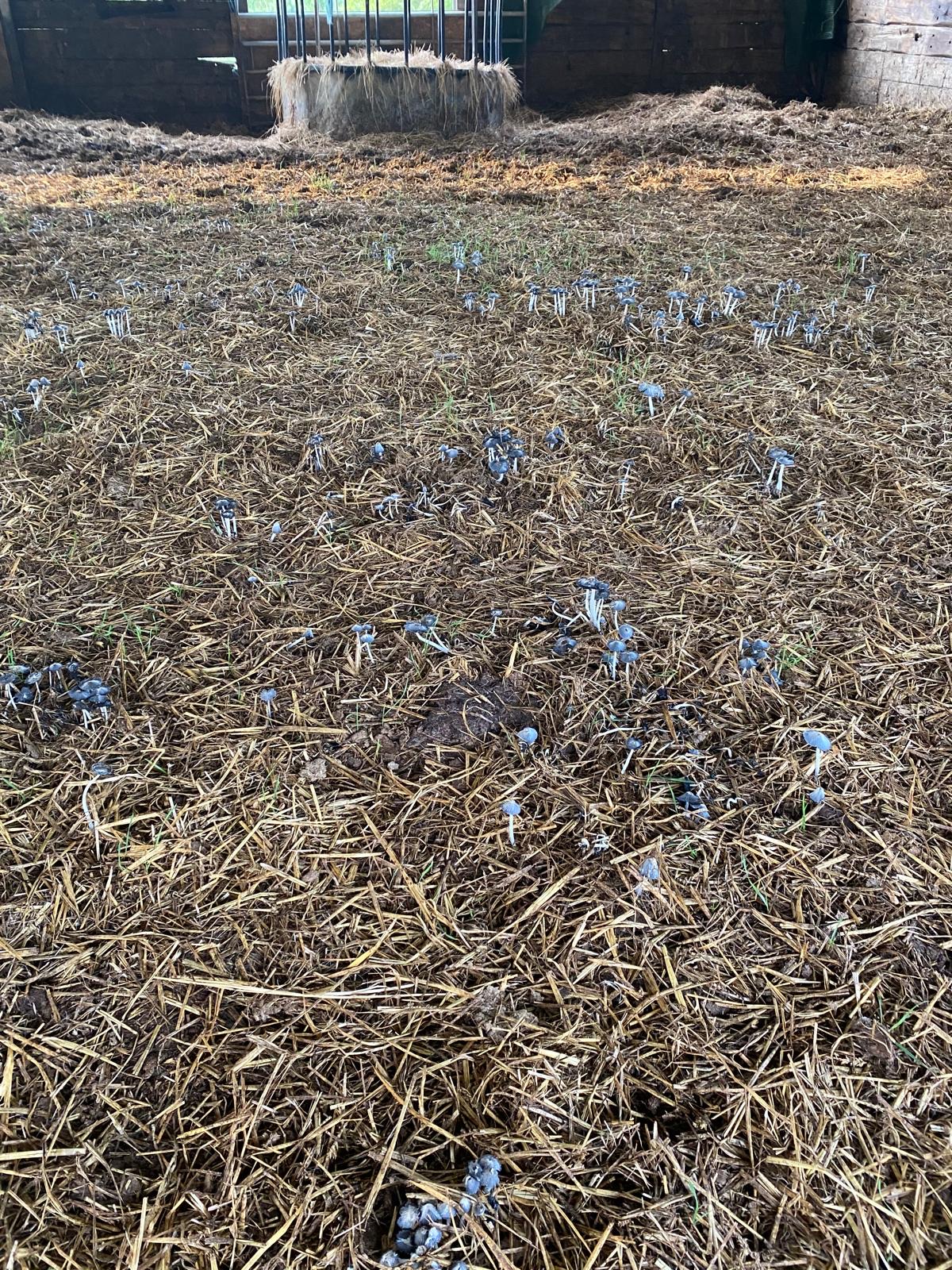
Sprinkled on the bedding at 1 kg a cubic metre as the shed fills, it works from the animal onward: drier beds, less smell, less straw. In poultry housing, 82% less nitrogen was lost to the shed air and the organic nitrogen in the litter was up 39%.
You stack the manure and leave it until it is wanted.
The heap composts down on its own, with no turning, and keeps what it has. Dry matter loss over two months was halved, 17% against 34%, and the French trial kept 150 tonnes more manure per 1,000 after two months, 780 against 630.
You agitate the pit before spreading and fight the crust.
At 2 kg a cubic metre as the pit fills, the slurry comes out uniform, with no crust or deposits, and spreads evenly. In the laboratory, nitrogen leaching from treated slurry was down by a third and its stable carbon, as humic acids, more than doubled.
You count the loads and spread the nearest fields first.
Richer manure tonne for tonne. Treated poultry manure carried 9% more total nitrogen, 24% more ammoniacal nitrogen, 16% more potash and 57% more calcium per tonne than untreated, so the same loads do more on the field.
You spread the manure as normal in spring.
The treated manure carries the living biology onto the fields it goes to, never under 30 kg a hectare, so those fields are on the system without a separate pass. Bacteriolit covers the manure fields, Bacteriosol the rest, never both on the same ground in a season.
Figures from SOBAC’s trial record, as printed in our company brochure: AGRA-OST, Belgium, 2003, soil nitrogen in the top 45 cm from December to March; ITAVI, the French poultry institute; AgroParisTech experimental farm, 2010; INRA, Exmes, 2002; Lara Europe Analyses; the cooperative farmers of Janzé, samples analysed at a departmental laboratory.
“I noticed there was a reduction in smells almost instantly and the livestock seemed to be happier in the barns. The beds stayed drier which meant I used less straw.”
Hugh D., Warwickshire. Bacteriolit on the bedding, three times through the winter.

Bacteriosol goes on the land in autumn or spring. Through the winter the same biology goes into the manure as Bacteriolit, and the manure comes out in spring with its nitrogen held, ready for the soil.
1 kg a cubic metre of the manure the shed will make, sprinkled on the straw in stages through the winter. Less smell, drier beds.
2 kg a cubic metre of slurry. It comes out uniform and spreads evenly.
A heap not treated in the shed gets the same 1 kg a cubic metre as it builds. It composts down on its own, no turning, and keeps its dry matter and nitrogen.
Never under 30 kg a hectare on the fields the manure goes to; graze again from two weeks after. No Bacteriosol on those fields that season.
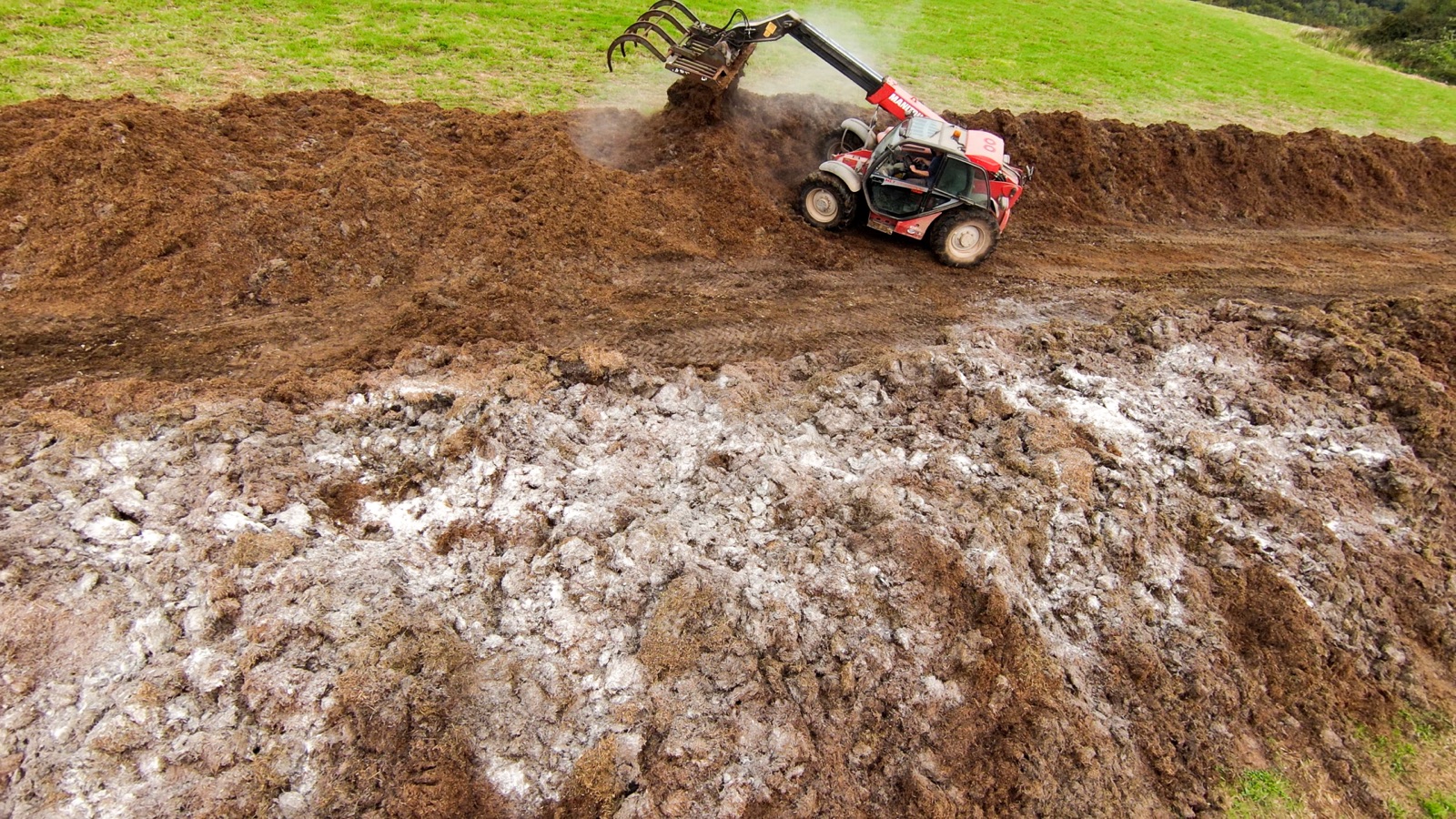
How a windrow is laid out decides how evenly it breaks down. When the shed is cleared, the manure goes out to the field in straight rows, each started at the bottom end and left as the trailer tipped it, the next row against the last.
Tipping the windrows. Seen from above on the left: straight rows, side by side and touching, each started at the bottom end and left as the trailer tipped it. On the right, a row cut across: about six feet tall, the next one against it.
Start each row at the bottom end, drive straight and tip as you go, so the row is the same depth from end to end. Put the next row against the last, touching but not on top of it, and do not push the rows up into one bigger heap. A row left as tipped lets the air and the biology into all of it, so it breaks down evenly, with no cold wet core and no hot dry crust.
Loose, straw rich manure breaks down slowly as it is. Mix Bacteriolit into it and row it up to about six feet tall in straight rows, side by side and touching. Left like that, it should be broken down enough to spread after the first graze or cut: it goes on in spring as composted manure rather than straw.
Farmyard manure of all kinds.
Livestock slurry & effluents.
Plant & composting material.
Anaerobic digestion output.
Simply apply Bacteriolit directly to your manure, slurry, green waste or digestate.
As a guide, one 500 kg bag treats about 500 cubic metres of farmyard manure, roughly 400 tonnes, at 1 kg a cubic metre, or 250 cubic metres of slurry at 2 kg. Tell us your tonnes and cubic metres and we size the bags, alongside the Bacteriosol for the rest of the farm. Available in 500 kg bulk bags or 20 kg bags on a pallet.
Get my quantities
Tap to see the product
Quaterna Sol carries the same living microbes as Bacteriosol, the fungi and bacteria that build humus and recycle the nutrients already in your ground, now in a form you spray on.
It is made for arable farmers who already cover their fields with the sprayer. No spreader, no separate pass, just the regenerative biology of SOBAC applied the way you already cover your fields.
Request pricing & dataApplied through your own sprayer, no new kit and no specialist contractor.
A liquid pass lays the biology evenly across the field, right to the tramline edges.
The biology establishes and stays, so each season starts further on than the last.
The same Marcel Mézy microbes proven across SOBAC, simply in a sprayable carrier.
Accelerates humus formation and unlocks the minerals already in your soil, season on season.
No synthetic inputs, the soil-first SOBAC system you already trust on the land.
No new kit, no separate trip across the field.
Quaterna Sol goes into your own sprayer, ready to apply across arable ground.
We tailor the exact rate and water volume to your sprayer, soil and cropping, so every hectare gets the right dose.
The microbes establish and work through the season, with cumulative gains year on year, just like Bacteriosol.
We tailor every quote to your acreage, application method and goals. Tell us about your farm and we'll send pricing and full technical information.
Request pricing